Showing posts with label Daily Life. Show all posts

Ancient Egypt Worksheet - FREE Lesson Plan

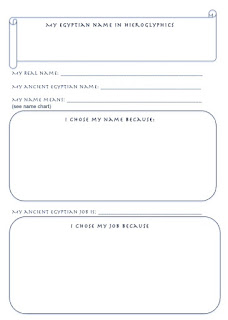
Who Am I In Ancient Egypt? 
Decide if you're a baker, farmer, architect, sandal maker or more! Then, choose your Egyptian name. When you're ready, introduce yourself to your classmates and start trading cards! 

FREE Lesson Plan. Includes the following Common Core standards: Writing, Speaking and Listening, Comprehension and Collaboration.

Ancient Egypt common core lesson plan activityAncient Egypt common core lesson plan activity


10 Fun Facts About Ancient Egyptian Wigs

Egyptian woman in a wig

Ancient Egyptian Wigs

We put together this list of 10 facts to answer your most pressing questions about these amazing historical artifacts.

Whether you're a kid, teacher, homeschooler, a student looking for homework help, a hairdresser, or just a curious fact-lover, we think you'll find this information fascinating!

Let's start off with the basics.

1. What were Egyptian wigs made of?

The nicest wigs were made from human hair. These were also the most expensive. An accounts list from the town of Kahun put hair’s value in the same category as gold.

FACTS: 10 Fascinating Facts About Ancient Egypt Beer

beer in ancient egyptian hieroglyphics
Do you love beer? Have you ever wondered about its history?
Today we bring you 10 facts about ancient Egyptian beer.

[She] sent you to school when you were ready to be taught writing, 
and she waited for you daily at home with bread and beer. 
- Instructions of Ani, regarding his mother

1. Gift From The Gods

According to legend, Osiris (Egyptian god of the afterlife, renewal, and rebirth) taught the ancient Egyptians how to brew beer.

How did ancient Egyptians make papyrus paper?

Papyrus Plant
Papyrus Plant
Have you ever wondered how they made papyrus paper in ancient Egypt? I've broken it down into five simple steps.

FACTS: 5 Fascinating Facts About Egyptian Cotton

Lots of people have the same questions about Egyptian cotton. What is it and how is it different from regular cotton? Is it ancient? Have they been using it for thousands of years, since the time of the pharaohs? Let's dive in and get some answers.

1. Egyptian cotton not ancient.

First up, let's talk about how old this material is. The truth is, Egyptian cotton is NOT actually ancient. It hasn't been around for all that long. In fact, commercial production of cotton was introduced in Egypt by a man named Mohammed Ali in 1822.

Cotton | Kimberly Vardeman

FACTS: Ancient Egyptian Cure For Headaches

Ancient-Egyptian-Headache-Cure
Alexandrian Laurel by Michael Reck

According to a recent study, ancient Egyptians wore a garland of laurel leaves to cure headaches--including those brought about by one too many glasses of wine. David Leith, a historian at the University of Exeter translated a medical papyrus that outlines the method.

PHOTO of the Day: Ancient Egyptian Sandals

These sandals may be thousands of years old, yet clearly designs haven't changed much. I wonder if these hurt the wearer between the toes the way mine sometimes do? If the owner zoomed into the future and dropped by wearing them, they'd completely fit into the pile of shoes by the door . . .

Ancient Egyptian Sandals. Photo by Pava

Food for thought:

  • What sort of person wore them?
  • Where did they go wearing them?
  • Where did they buy them, in a market? Or were they custom ordered?
  • Are they comfortable?

Ancient Egyptian Cosmetics

Beauty and Cosmetics in ancient Egypt

Cosmetics have been around for millennia. Ancient Egypt had impressive makeup materials, tools for application, and various jars for storing it.

Egyptian Fact - Papyrus

Papyrus: pronounced "pa-pie-russ"

Paper made from the papyrus reed, the bulrush that grows along the Nile banks. Ancient Egyptian paper makers sliced the pith into long strips and made a double layer sheet – placing one layer of strips running down, the other running crosswise. Using a mallet, they pounded the paper. The plant's sap made it stick together into a single sheet.

Egypt exported papyrus until the 12th Century AD when rag and wood pulp paper began to replace it.

What Does Ostraca Mean? Hint: It's Ancient Egyptian


Ostraca: pronounced "oh-stra-ka"


Osctraca is a thin, smooth flake of limestone used by ancient Egyptians for making notes, sketches and calculations. 

Basically, in the Nile Valley, people had access to a lot of this type of stone. Limestone is unique in that it flakes very easily when you chip at it. Hand-sized flakes could be separated from the larger block. They would be extremely thin and flat. This made them perfect for writing quick notes on, especially since very few people had easy access to papyrus paper. You might call Ostraca the 'sticky-note' of the ancient world!

Ancient Egyptian Foods: Meat, Fish, Poultry, Dairy

Common meats and dairy products eaten in ancient Egypt: 
image: ancient Egypt food
Goose
image: ancient Egypt food
Duck
image: ancient Egypt food
Pig
image: ancient Egypt food
Lamb
image: ancient Egypt food
Goat
image: ancient Egypt food
Fish
image: ancient Egypt food
Cow
image: ancient Egypt food
Milk
image: ancient Egypt food
Eggs

Yogurt
image: ancient Egypt food

Cheese


Ancient Egyptians enjoyed a varied diet. 

Meat: Wealthy peopled tended to eat more meat than the average Egyptian. Less fortunate people dined on fish and legumes.

Eggs are included here, however they were somewhat uncommon. Any eggs eaten would have been from geese, ducks or certain birds, but not chickens. Chickens were unknown in ancient Egypt until very late.

Milk: Given the Egyptian heat, milk had to be consumed shortly after milking or it would spoil. Milk, therefore, was made into cheeses and fermented products like yogurt.

Did Kids Have Toys in Ancient Egypt?

Egyptian Senet Game Board
Senet Game Board possibly from the tomb of Amenhotep III

According to archeologists, YES!

Apparently, ancient Egyptian children loved playing with toys and games as much as kids do today. If you could step back in time, you might find kids playing a rowdy game of street hockey with a ball and sticks.

Trending Now

Privacy Policy

We do not share personal information with third-parties nor do we store any information about your visit other than to analyze and optimize your content and reading experience through the use of cookies. You can turn off the use of cookies at any time by changing your specific browser settings. We are not responsible for republished content without our permission. This privacy policy is subject to change without notice and was last updated on Aug 8, 2020.
Copyright Scott Peters